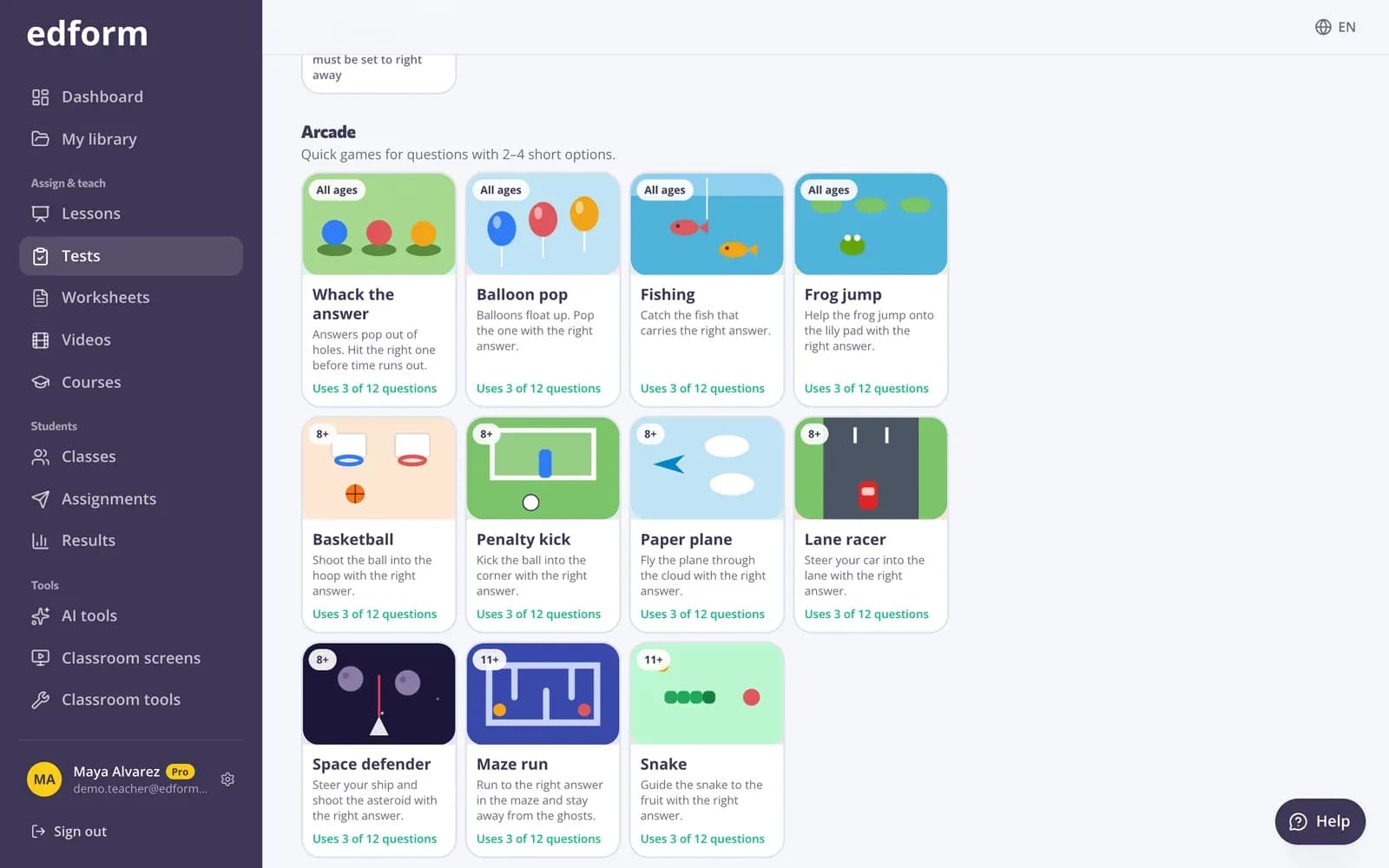
Pick a game mode
Step 1: Open the homework or live game settings
Go to “Tests”, click “Use with class” and choose “Homework” or “Live game”.
Step 2: Choose an audience other than “College”
Game modes and scenes are offered for “Young learners”, “Middle school” and “High school”. “College” uses a calm exam layout without games.
Step 3: Pick a mode under “How students answer”
Modes are grouped into “Classic”, “Word games”, “Arcade” and “Boards & adventures”. Each card shows the age it suits and how many of your questions it uses.
Step 4: Check which questions it uses
A mode can only use questions that fit it, for example one-word answers for a crossword. The other questions are answered as a classic test. Modes that show letters or answers need “Show the correct answers” set to “Right after each question”.
Step 5: Add a game scene (optional)
Under “Game scene” pick a picture such as a summit climb or a Moon mission. Each correct answer moves the student along; scores don't change. Choose “No scene” for a simple progress bar.
Step 6: Give the homework or open the game
Students play the mode on their own devices, and you see their results as usual.
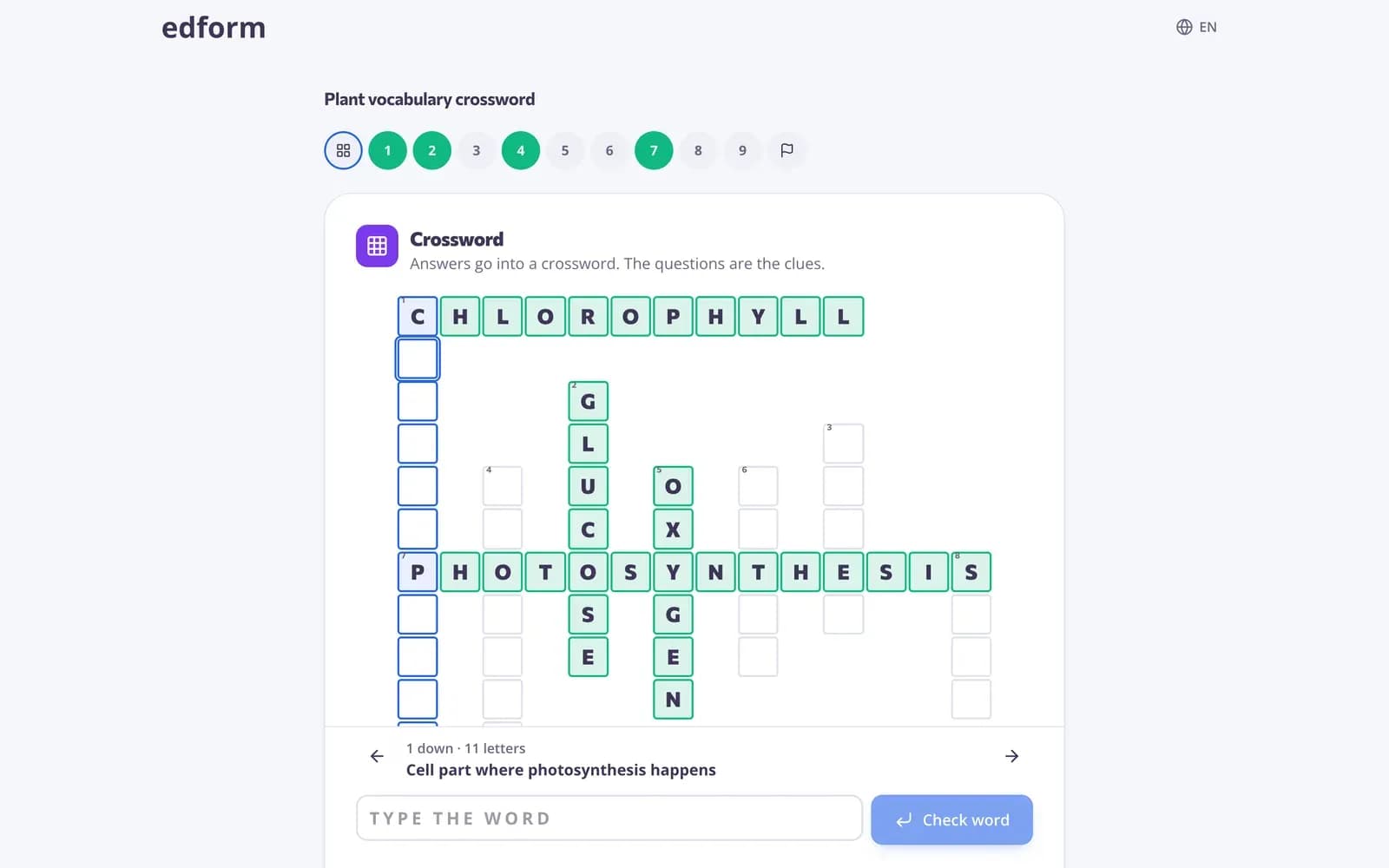
Which modes there are
Classic: Classic test, TV quiz (against the clock, with two 50:50s), Typing race. In timed modes the clock of a question starts when the student presses “Start”. Word games, for one-word answers: Guess the word, Anagram, Missing letters, Crossword, Word search. Arcade, for questions with 2–4 short options and one right answer: Whack the answer, Balloon pop, Fishing, Frog jump, Basketball, Penalty kick, Paper plane, Lane racer, Space defender, Maze run, Snake. Boards & adventures: Match up, Find the match, Bingo, Memory, and whole-test adventures: Quiz board, Escape room, Board game, Tower builder. Questions on a crossword, word search or match-up board are answered on the board, and in Memory only matching pairs are saved, so a wrong flip never costs points.
Other ways to play the same questions
The test's “Use this test” page also has a team game for one screen, flashcards, pairs (match-up and memory) and printable puzzles. They all use the questions you already wrote.
Questions
Do game modes change students' scores?
No. Every mode ends in a normal answer that is graded the same way, so your report looks the same whatever mode students played.
Why can't I pick a mode for my test?
Each mode needs questions that fit it, such as one-word answers or short options with one right answer. Add fitting questions or pick another mode.
Can I use game modes in a live game?
Yes. The live game settings have the same “How students answer” picker and game scenes.
Related
- Game modes27 ways to play the same questions
- Escape room makerTurn a quiz into a digital escape room
- Quiz board gameA review board of questions and point values
- Assign homeworkGive a test as homework with a code, link or QR code and set the deadline.
- Live raceRun a live race: students join with a code and race on your screen at their own pace.